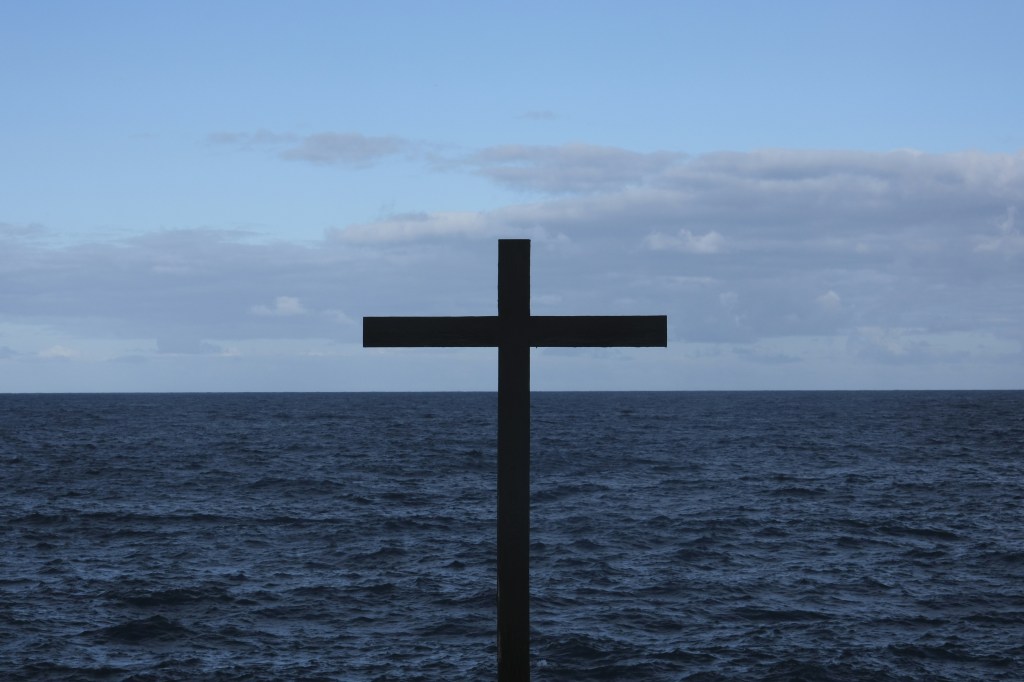
I was raised Protestant, more by my grandmother than anyone. She was the religious one. She’d teach me Bible verses and then have me recite them for her church friends, this little girl standing in front of grown-ups, delivering scripture from memory. I can still feel what that was like, the wanting to get it right, the small pride when I did.
My mother had a different approach, and I’ve come to appreciate it more the older I get. She didn’t want us forced to go to church. So we didn’t, mostly. We’d go on some holidays, and we’d visit the Mormon church at Christmas to see the lights and the nativity scenes all lit up, which to a child felt like magic more than doctrine. But she never made faith a requirement. She wanted it to be something we came to, or didn’t, on our own. She gave us the freedom to choose, and I don’t think I understood until much later what an unusual and generous thing that was to hand a child. And I did believe. As a kid, I believed genuinely, all the way down. It wasn’t complicated then. There was a God, and He was good, and He listened.
Then my mom got sick. And I leaned in. I leaned in the way you do when you’re terrified and someone has told you your whole life that there’s a power that answers if you ask. I prayed. I begged. I pleaded. I made the deals people make, the I’ll do anything, take anything, just not this. I did all the things you’re supposed to do, all the things I’d been taught worked, all the things a person does when praying is the only thing left to do and you do it with your whole body.
She didn’t make it. I’m not going to dress up what that did to my faith, because it was quieter than a dramatic loss of belief. I didn’t shake my fist at the sky. I didn’t declare there was no God. I just got very quiet about the whole thing. I had asked with everything I had, in the exact way I’d been promised worked, and the answer was no. And after that I couldn’t quite stand in the same relationship to it that I’d had before. Something between me and the church I’d been raised toward simply went slack. Not with anger. With a kind of tired uncertainty that I’ve carried ever since.
I believe there is something. I do. I haven’t gone all the way to the other shore and decided the lights just go out and that’s the end. I feel the presence of something larger, something I can’t name and won’t pretend to. I believe in the ethereal, in the unseen, in the way certain things move through a life that can’t quite be explained by the visible mechanics of it. I believe in intention, in manifestation, in the strange gravity of what we call toward ourselves. There’s a sacredness I never lost, even when the church slipped away from me.
What I don’t have is a building. I don’t have a congregation or a doctrine or a set of Sundays. My faith, whatever it is, lives outside all of that now, out where my mother pointed me when she declined to force it: somewhere I found on my own, or am still finding.
I wrestle with religion, the institution of it, the human uses of it. I have watched it turn, in certain hands, into a weapon. I hate it in politics. I hate it most of all when people wield it as a reason to take rights and dignity away from others, when the thing that was supposed to be about love gets bent into a tool for deciding who deserves less. That is the opposite of the something I believe in. Whatever the sacred is, I am certain it was never meant to be used to make people smaller.
I don’t have this resolved to be honest. I’m a person who believes in something and belongs to nothing, who felt God as a child and felt abandoned by Him as a young woman and has spent the decades since somewhere in between, in the wide uncertain country where a lot of us actually live.
But I know what I want for my kids, and it’s the thing my mother wanted for me. I want them to explore. I want them to read and question and sit in different rooms and feel what they feel and come to their own conclusions, uncoerced. I don’t want to hand them my rupture any more than I want to hand them someone else’s certainty. I want them to have what my mom gave me: the freedom to choose, and the dignity of arriving at their own belief, whatever it turns out to be.
I prayed for my mother with everything I had, and it didn’t save her. That’s the plain fact at the center of my faith, and I’ve stopped trying to make it mean something tidy. But I notice I still talk to something, in the quiet, when no one’s around.
I just never quite managed to stop reaching for it. Maybe that’s its own kind of faith. It might be the only kind I’ve got.
 Whatever Held
Leave a comment