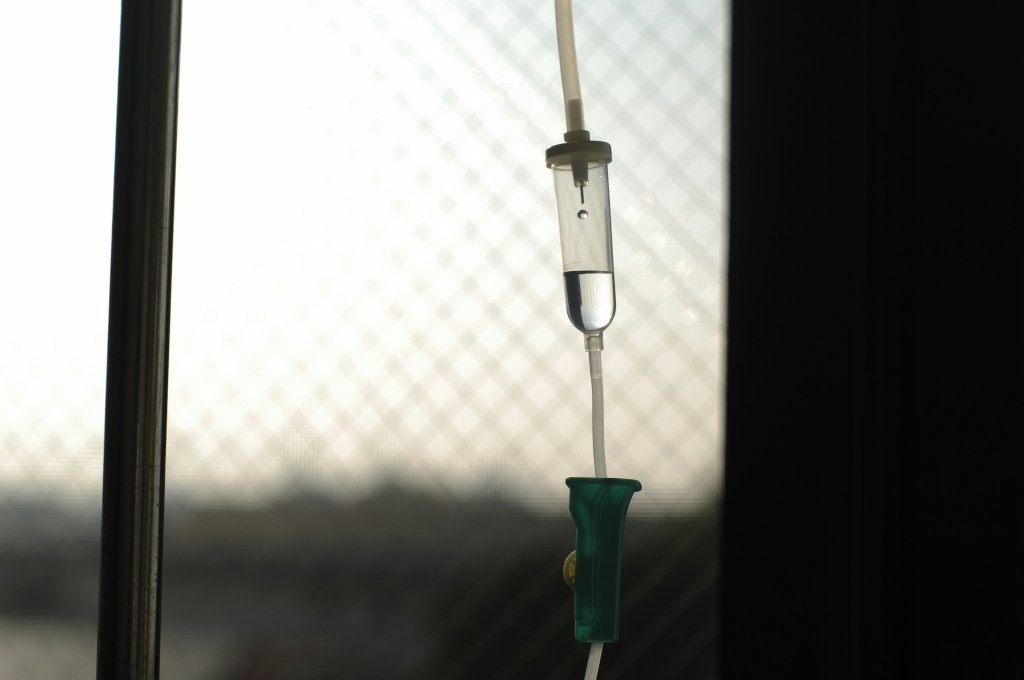
The chair. The beeps. My whole body tense, every time, for a year.
That’s what comes back first. Not the medicine, not the diagnosis, but the chair I sat in and the sound of the machines and the way my body braced itself the moment I walked in, before anything had even started.
I went alone. Every time. Nobody sat with me in that room.
The first infusion was supposed to happen on a day it didn’t. I’d worked myself up to it for days. The unknown of it was the worst part, not knowing what it would feel like, what it would do to me, who I’d be on the other side of it. I got there braced and ready, and they’d gotten the medication wrong. Ordered wrong, received wrong, something. So I went home, and I had to come back a few days later and be brave all over again. I’ve thought about that since. That the first time wasn’t even the first time. That I had to summon it twice.
By then I was already deep into it. Eight months or so of testing, radiation, surgery. All of that came before the chair. Then a year of infusions and shots. It was a marathon. People imagine cancer as a crisis, a sharp terrible moment. It isn’t. It’s a job you show up to, over and over, until you can’t remember what your life was like when you didn’t have it.
And here is the strange thing, the thing nobody warns you about. It developed a rhythm.
The fear didn’t last, because fear can’t sustain itself over a year. It burns down into routine, and routine is survivable. I learned the pattern. I knew the drive, the chair, the beeps, the order of things. I knew exactly how long I had after an infusion before the sickness would come for me: about two hours. Two hours to get home, to get settled, to be where I needed to be before it started. I could set a clock by my own poisoning. That’s what a year does. It turns terror into a schedule.
There were two nurses.
One was serious. She was the one who was supposed to give me that first infusion, the one that didn’t happen. She was brisk, professional, no softness to spare.
The other one was lighter. She worried about my weight. I was disappearing, and she noticed, and every single time I came in she’d tell me the same thing: eat Chinese food. She thought it had a lot of calories. That was her whole prescription. Not a nutrition plan, not a lecture. She was just this woman, watching a body vanish in front of her, doing the one small thing she could think of to put something back. I still think about her telling me that. She wasn’t treating my cancer. She was trying to take care of me.
I watched the room, the way you do when you sit in it long enough.
There was a middle-aged man who spent his infusions on his cell phone. At first, he had the energy of a man in an airport lounge. He was surprisingly relaxed, chatty, working through his contacts like this was any ordinary Tuesday. But it was his test results he was talking about. His numbers. His prognosis. Call after call, updating everyone he knew, telling the same story down the line to whoever picked up.
So, we all learned it. His counts, his scans, what the doctor had said, what came next. Nobody in that room asked to be in the loop on a stranger’s mortality, and yet there we all sat, hooked to our own drips, quietly becoming experts on his. I never spoke to him. I knew his prognosis anyway.
And there were the other ones. They were the very sick, the ones who couldn’t walk in, who had to be wheeled through the door on beds. Both of those things were true about that room at the same time. It was mundane and it was a place people were dying in.
I was the youngest person there. Always. And the other patients noticed.
They’d say things to me. Kind things like condolences, sympathy, that soft tone people use for tragedy. And I could never quite hold what that meant. These were sick people. Some of them much sicker than I was. And they were sorry for me. As though their own illness was the expected order of things, and mine was an outrage, a mistake, something that shouldn’t have been allowed to happen. Being pitied by people who were dying is a
strange, unforgettable thing. Their sympathy told me exactly what they were seeing when they looked at me- someone too young to be in that chair.
My middle girl would sometimes come along for the drive. She couldn’t come in, of course. That room is no place for a child, and they don’t allow it. So, she’d wait outside.
But she’d find the doorway. Her face would appear around the frame — just her head, just for a second and she’d grin at me. Big and bright and completely delighted with herself, like she’d pulled off something clever, like she’d found a way in after all.
That’s the picture I kept. Not the chair or the beeps or the pity or the medicine. A little girl’s face in a doorway she wasn’t allowed through, grinning at her mother.
She couldn’t come in. So, she came as close as she could get, and she made sure I saw her.
A year of that room. And what I remember is the door.


Leave a Reply